 The original Heineken brewery is located in Amsterdam, and the building is now a museum which has shamelessly dedicated itself to the green-bottled lager. Even though Heineken stopped producing beer there in 1988, we still had to have the "Heineken experience."
Wednesday, February 20, 2008
Heineken
The original Heineken brewery is located in Amsterdam, and the building is now a museum which has shamelessly dedicated itself to the green-bottled lager. Even though Heineken stopped producing beer there in 1988, we still had to have the "Heineken experience."


Bicycles galore

 Because the Netherlands is such a small country, most everything is accessible by bike. Despite what I thought were frigid temperatures and gusty winds, we saw many of Amsterdam's residents with frostbit cheeks as they rode their bicycles from one place to another. Honestly, as Brian and I made our way around the city by foot, we were more careful on the bike lanes than the roads themselves because we were almost mowed down by the bicycles on more than one occasion.
To give you an idea of just how many bikes there are in the city, check out this multi-level parking garage packed full of them!
Vondelpark

 After a long day, we decided that we needed to rest in the park before doing anything else. Vondelpark is famous for its meandering walkways, green meadows, several ponds, and a pathway which extends 1.5 km for bikers and skaters. This English-style park is the largest in the city's center and is named after 17th-century poet and playwright Joost van den Vondel.
Van Gogh Museum

 The last stop on our schedule for the day was the Van Gogh Museum, which boasts of the largest collection of van Goghs in the world. My favorite piece was "Sunflowers," which has always been my favorite of van Gogh due to my personal bias for the flower. The museum also features a diverse group of 19th-century paintings by other artists of the time that van Gogh admired, such as Gaughin and Emile Bernard.
It was truly an amazing experience being able to see so many famous works of art firsthand.
Sunday, February 17, 2008
Rijksmuseum

 Our next stop for the day was the Rijksmuseum, which is an art museum that houses an impressive collection from the Dutch Golden Age. We must have seen millions of dollars worth of art, including works by Rembrandt and Vermeer. In fact, Rembrandt's famous piece entitled "The Nightwatch" was on display.
Tuesday, February 5, 2008
Westerkerkstoren Tower
 As we were walking, we passed this tower which is part of the Westerkerk Protestant church located near the Anne Frank Huis. It was designed by Roman Catholic architect Hendrick de Keyser and completed in 1631. It is actually one of the last buildings designed in the Dutch Renaissance style, with the typical mix of brick and stone.
On the Road Again...
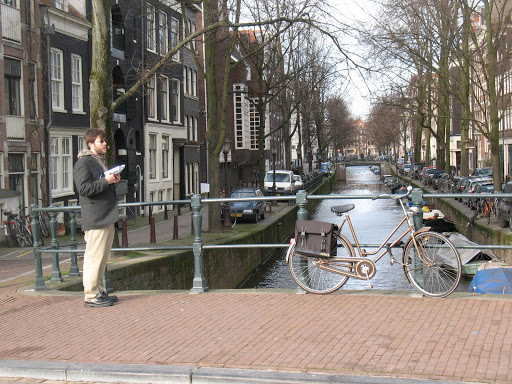 After visiting the Anne Frank Huis, it was time to make our way to the Rijksmuseum. Given that I have such a terrible sense of direction, we always put Brian in charge of the map!
Anne Frank Huis

 The next morning, we decided to hit some of the other museums in Amsterdam. To start off the day, we went to the Anne Frank Huis, where Anne Frank wrote her famous diary during WWII. Anne Frank and her family, along with another Jewish family, lived in a secret annex in hiding from July 6, 1942 to August 4, 1944, when the building was stormed by the German Security Police. Upon their discovery, everyone in hiding was seized and deported to various concentration camps. Unfortunately, Otto Frank, Anne's father, was the only one who was able to survive the horrors of life at the mercy of Nazi Germany. Anne died of typhus in Bergen-Belsen just one month before the Allied victory in early March of 1945.
The museum documents her life during her years in hiding and has the actual diary on display, which is admirably optimistic with only hints of what must have been unsurmountable despair.
Today, the museum is just as it was when Anne and her family spent their last days there. The original furniture has been removed, but you can still see the pictures of 1940s movie stars and a young Queen Elizabeth adorning the walls of her narrow room. Even the pencil marks that Anne's mother, Edith Frank, made on the walls to denote the heights of her children are still preserved.
The top picture is of the house itself, which is located directly on the Prinsengracht, one of the many canals dissecting the city. The lower picture is probably what the view was like from inside the annex for its residents during their 25 months in hiding.
Sunday, February 3, 2008
Red Light District
 After spending the day in the museum marveling over art, we went to the Red Light District to take in a different sort of spectacle. When night falls, the area actually glows red. Sex theaters throw open their doors and the streets are packed with people gawking at the scantily-clad prostitutes propositioning passers-by from black-lit windows. The profession is legal in the Netherlands, with a number of security measures in place to prevent violence against the women, STDs, etc.
Most of the sex workers are women. Ironically, a few years back three men attempted to follow the lead of their female colleagues. The men positioned themselves in a window, but they were instructed not to quit their day job because the women were simply not taking their bait. One of the female prostitutes even described the incident as "filthy." Talk about the pot calling the kettle black! Ouch!
Stedelijk Museum of Modern Art
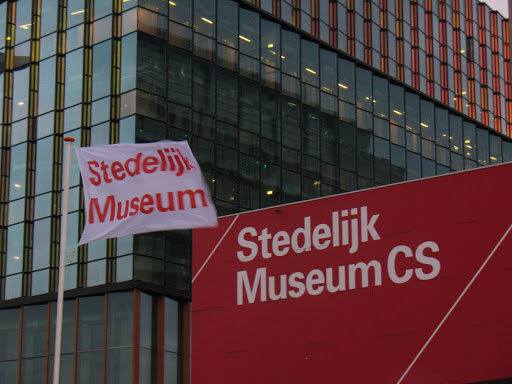
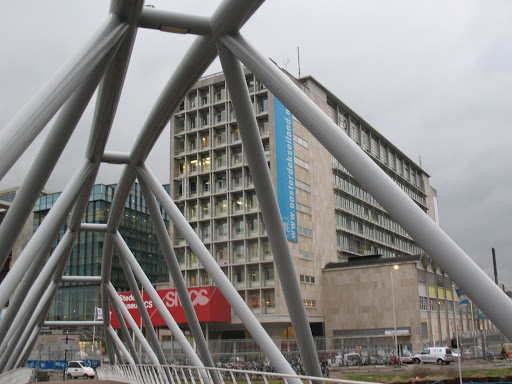 For our first full day in Amsterdam, we went and explored the Stedelijk Museum, which was literally across the waterway from our hotel. It has an extensive collection of contemporary art that is on par with MoMA.
Hotel
 Our hotel was very centrally located, directly facing the Oosterdok waterway. Our room was on the third floor, so the view of the city was absolutely amazing. If you look at where all of the flags are at the base of the buildings, there is a "hotel" sign just to the left for Y Boulevard, which is where we stayed. The window to our room was the second one above the sign.
Amsterdam
 To take advantage of the break in between the two semesters, Brian and I went to Amsterdam from January 30th until February 2nd to meet Grey, a good friend of ours who lives in Portland, Oregon. We flew in late Wednesday evening and took a train to Centraal Station, where we began the walk to our hotel just a few blocks away.
Saturday, February 2, 2008
Dublin, Ireland
 In order to connect through to Cork, we had to change planes in Dublin. This is the view of the Irish coastline just before you land in the capital. Even though we weren't there for very long at all, it was just long enough to be able to take a few good pictures...
Boom Femenino in Mexico: Reading Contemporary Women's Writing


During the conference, I had the opportunity to meet a number of colleagues in the field in addition to Ana Clavel, a contemporary Mexican writer who is currently residing in Mexico City. The top picture is of Ana and I just before the close of the conference, and the group picture below was shot directly after all of the concluding remarks.
University College Cork
 As I said before, the main reason why we were in Ireland was so that I could participate in a conference that was taking place at University College Cork. The conference was entitled, “The Boom Femenino in Mexico: Reading Contemporary Women’s Writing” and focused on the increase in literary production by female writers of Mexico since 1980.
 I cannot begin to thank everyone who participated for the ideas that they shared in their papers as well as the thoughtful questions and comments that you provided me with after my presentation. It was such an enriching experience to meet other people who are just as passionate about women’s writing and Mexico as I am!
Subscribe to:
Posts (Atom)
